
Junk Removal vs. Dumpster Rental: Cost, Convenience, and Which Option Is Right for You?
A detailed comparison of junk removal and roll-off dumpster rentals to help you decide the most cost-effective and convenient waste disposal method for your next project.

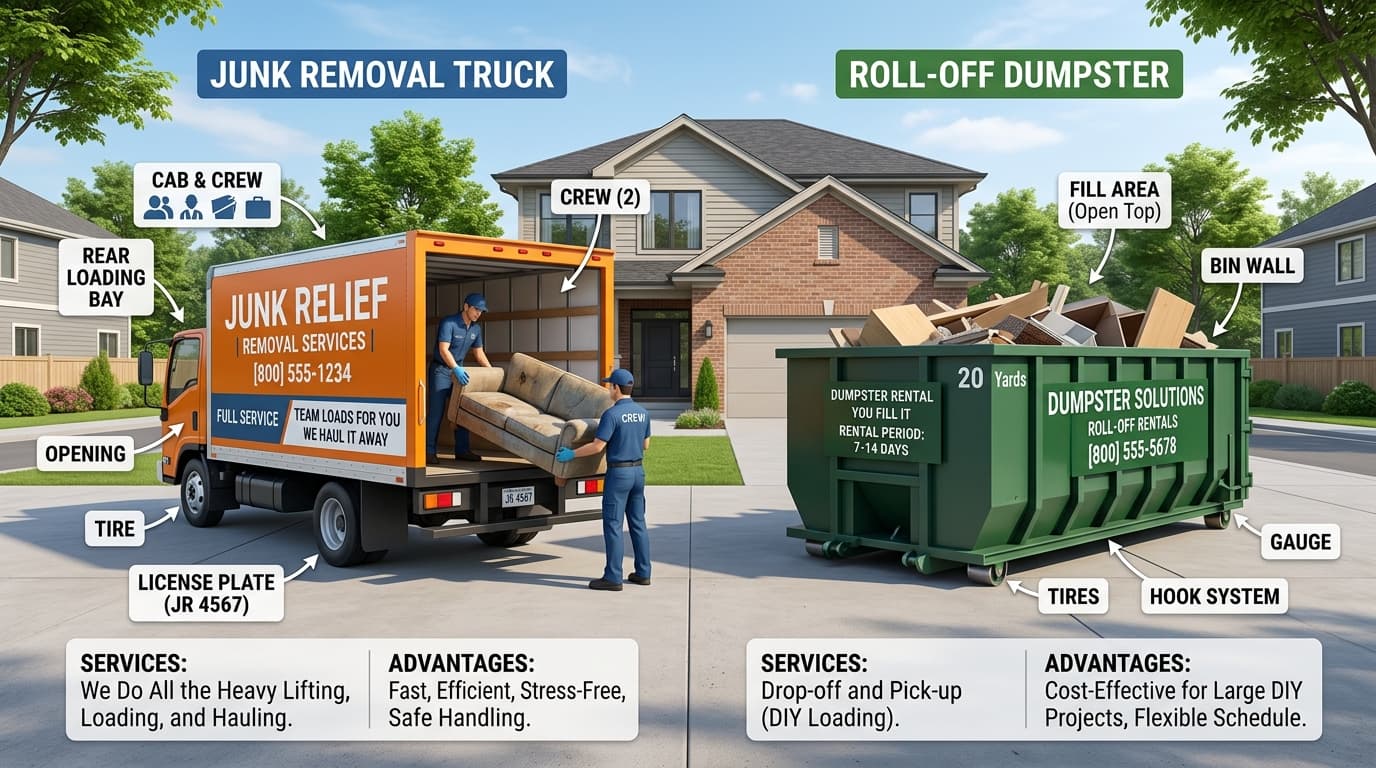
When facing a major cleanout, renovation, or move, you generally have two main waste disposal options: junk removal or dumpster rental. Both cost money, but they operate entirely differently.
Junk removal is primarily a service. A crew comes to your property, loads the material into their truck, and transports it away. Dumpster rental, on the other hand, is primarily a container. A dumpster is delivered to your property, you load the debris yourself over a defined rental period, and the provider later collects it.
Comparing only the advertised price can be misleading because these options include different amounts of labor, time, capacity, and risk. The best choice depends heavily on your specific project, physical capabilities, and timeline.
Quick Answer: Junk Removal vs. Dumpster Rental
To choose the right solution, you need to understand the fundamental differences in how each option operates.
| Factor | Junk Removal | Dumpster Rental |
|---|---|---|
| Cost structure | Based on truck volume and labor | Based on container size and weight |
| Loading labor | Done by the crew | Done by the customer |
| Typical project duration | 1–3 hours (one visit) | 7–14 days (rental period) |
| Space required | Temporary parking for the truck | Dedicated driveway/street space for days |
| Best for small jobs | Yes (pay for what you use) | No (flat base rate for the container) |
| Best for large jobs | Can require expensive multiple trips | Yes (holds large volumes efficiently) |
| Best for multi-day projects | No (truck leaves after loading) | Yes (container stays on site) |
| Heavy lifting | Handled by professionals | Customer responsibility |
| Scheduling | Appointment window required | Delivery and pickup dates required |
| Potential permits | Rarely needed | Often needed for street placement |
| Weight limits | Rarely a concern for typical junk | Strict tonnage limits with overage fees |
| Potential extra fees | Stairs, heavy/specialty items | Overweight, extended days, prohibited items |
Local pricing, the size of the dumpster, weight allowances, the type of material, and labor requirements can change the result considerably. There is no universal "break-even point" where one option automatically becomes cheaper than the other.
How Junk Removal Works
When you hire a full-service junk removal company, a crew arrives at your property during a scheduled appointment window. You identify the items that need to go, and the crew performs the loading, lifting, and basic cleanup. The material is then transported away for disposal, recycling, or donation.
Pricing commonly depends on the volume your items take up in the truck, the type of items, labor or access difficulties, and local disposal requirements. Jobs are generally completed during one scheduled visit.
Standard service includes moving items from inside your house or yard to the truck. However, certain factors may trigger additional charges:
- Navigating multiple flights of stairs
- Long carries from the house to the street
- Disassembly of furniture, sheds, or playsets
- Surcharges for mattresses, TVs, and appliances with Freon
- Very heavy items like pianos, safes, or hot tubs
- Dense construction debris like concrete or dirt
For a deep dive into average truck capacities and regional pricing variations, review Jenexo's guide on US Junk Removal Pricing: Truck, Weight, and Regional Costs.
How Dumpster Rental Works
With a dumpster rental, a roll-off container is delivered to your property and placed in your driveway or on the street. You load the debris yourself. The container remains on-site for the agreed rental period—typically one to two weeks—and the provider collects it afterward.
Dumpster rental pricing can depend on:
- Container size (usually measured in cubic yards, e.g., 10, 20, or 30 yards)
- Rental duration
- Delivery area and distance to the landfill
- Included weight or tonnage allowance
- Landfill disposal fees
- Overweight charges (per ton)
- Additional rental days
- Prohibited materials penalties
- Failed delivery or blocked pickup fees
- Relocation of the container during the rental
- Local permit requirements
Dumpster size labels and weight allowances can vary by provider. It is important to understand that volume capacity and weight capacity are not the same thing. Dense materials such as concrete, brick, dirt, and roofing material can reach a dumpster’s safe weight limit long before the container is physically full.
To properly size a container for your project, consult Jenexo's Dumpster Rental Planning Guide or our Cubic Yard Visualizer.
Junk Removal vs. Dumpster Rental Cost
Comparing the cost of junk removal to dumpster rental is not a perfect apples-to-apples comparison. Junk removal usually includes labor, whereas dumpster rental generally requires the customer to perform the loading.
As of 2026, the national average cost to rent a standard dumpster in the United States ranges between $285 and over $1,000, with typical weekly rentals falling between $440 and $650 depending on the size and market (according to Angi and ConsumerAffairs data). A typical 20-yard dumpster averages around $500–$670 per week.
Junk removal costs vary based on truck volume. A minimum pickup fee (for a single item like a mattress) averages $75 to $150. A half-truck load averages $250 to $400, while a full 15-to-16 cubic yard truckload typically costs between $500 and $800.
| Scenario | Junk Removal | Dumpster Rental | Important Consideration |
|---|---|---|---|
| A few bulky items (e.g., mattress and old TV) | $100 – $200 | $300 – $400 (10-yard) | Junk removal is almost always cheaper for small volumes. |
| Small garage cleanout (approx. half a truck) | $250 – $400 | $350 – $450 (10-to-15-yard) | Pricing is often comparable; the choice comes down to labor preferences. |
| Full-truck household cleanout (15 cubic yards) | $500 – $800 | $400 – $600 (15-to-20-yard) | A dumpster may be cheaper if you are willing to do the heavy lifting. |
| Large home or estate cleanout (multiple trucks) | $1,200 – $2,500+ | $600 – $900 (30-to-40-yard) | Renting a large dumpster is typically much cheaper per cubic yard than multiple junk removal truckloads. |
| Multi-week renovation | Usually impractical | $500 – $800 (including rental extensions) | Debris generated over time requires a container on site. |
There is no universal crossover point. The cheapest option depends entirely on how much junk you have, whether you can load it yourself, and local landfill rates. You can use Jenexo's Junk Removal Cost Calculator to estimate specific volume costs.
Costs That Are Easy to Miss
Both options have additional costs that may not be apparent in the initial quote.
For dumpster rental:
- Excess weight: If you exceed the included tonnage, you will pay a prorated fee per ton (often $50 to $100+ per ton).
- Additional rental days: Keeping the dumpster past the standard rental period usually incurs daily fees.
- Prohibited items: Tossing a tire, battery, or old refrigerator into a standard dumpster can result in significant fines.
- Permit fees: Street placement often requires a municipal permit.
- Failed delivery/pickup: If a parked car blocks the driver, you may be charged a "dry run" fee.
- Overfilled containers: Drivers legally cannot transport dumpsters loaded above the fill line and will charge you if they have to leave and return.
For junk removal:
- Additional truck volume: If you underestimate how much junk you have, you will pay for the next volume tier.
- Multiple trips: Exceeding the capacity of a single truck means paying for a second trip.
- Difficult access: Carrying items down a steep hill or multiple flights of stairs may incur labor surcharges.
- Dismantling: If the crew has to spend an hour taking apart a shed, you will pay extra.
- Specialty items: Mattresses and appliances often carry per-item disposal fees.
- Minimum service charges: Even if you only have one small box, you must pay the company's minimum stop fee.
Consumers should always request clear written terms before agreeing to a service.
Convenience and Labor
When deciding between the two services, compare the physical effort required.
Junk removal: The crew performs all the lifting. This is incredibly useful for heavy furniture, appliances, and awkward items that you cannot safely move yourself. The job is usually completed in a single, defined appointment window, meaning the mess is gone in a few hours without physical strain on your part.
Dumpster rental: The customer normally moves everything to the container. You must have the physical capability to carry heavy items out the door, across the yard, and over the rim of the dumpster. However, renting a dumpster gives you more control over the timing, which is useful when debris is generated gradually or when you want to take your time sorting through an estate.
How Long Does Each Option Take?
The timeline for your project often dictates the best choice.
Junk removal is best suited to material that already exists in a pile (or in specific rooms) and can be removed in one scheduled job. Clearing out a garage on a Saturday morning, getting rid of old basement furniture, or clearing a house on moving day are perfect scenarios for a two-hour junk removal appointment.
Dumpster rental is particularly useful when debris is created progressively over several days or weeks. Examples include a bathroom remodel where you tear out tile on day one, remove the tub on day three, and discard drywall on day five. An estate cleanout where family members spend two weeks sorting through a house also benefits from a standing container.
How Much Space Do You Need?
Site access heavily influences which option is viable.
For dumpster rental: You must have a suitable placement area, usually a private driveway. Delivery trucks need substantial overhead clearance (free of low-hanging wires or branches) to safely lift and roll the container into place. If you lack a driveway, you may need to place the dumpster on the street, which can trigger municipal rules or homeowners association (HOA) restrictions. Local regulations vary widely, and you must verify rules with the relevant municipality or authority.
For junk removal: The truck generally only needs temporary access during the scheduled service. The crew can park on the street or temporarily block a driveway while they load. However, if the parking access is exceptionally far from the debris (a "long carry"), it can affect the total price or the time the job takes.
Which Option Is Better for Different Projects?
To help you narrow down your choice, here is a breakdown of common scenarios.
| Project | Usually More Suitable | Why |
|---|---|---|
| Single couch or mattress | Junk Removal | A dumpster's base rate makes it too expensive for one item. |
| Several pieces of furniture | Junk Removal | Professional lifting protects your back and walls. |
| Apartment cleanout | Junk Removal | Dumpster placement is usually impossible or prohibited at apartments. |
| Garage cleanout (weekend) | Junk Removal or Dumpster | Depends heavily on whether you want to do the lifting yourself. |
| Basement cleanout | Junk Removal | Professional crews safely handle stairs and heavy lifting. |
| Moving cleanout | Junk Removal | Fast, single-day removal is ideal when vacating a property. |
| Estate cleanout | Dumpster Rental | Allows family members to sort items gradually over a week or two. |
| Bathroom/Kitchen remodel | Dumpster Rental | Accommodates debris generated day-by-day during demolition. |
| Roofing project | Dumpster Rental | Shingles are heavy and can be thrown directly into the container. |
| Construction debris | Dumpster Rental | Better suited for large volumes of wood, drywall, and siding. |
| Yard cleanup | Junk Removal | Fast removal of brush piles without taking up driveway space for a week. |
| Whole-home renovation | Dumpster Rental | Best for handling massive, ongoing construction waste. |
Exceptions exist for almost every project. For example, a large estate cleanout often favors a dumpster if family members are loading gradually. But junk removal may make more sense if the property must be cleared quickly and no one in the family can perform the manual labor.
When Junk Removal Usually Makes More Sense
Junk removal typically makes more sense when:
- The junk is already accumulated and ready to go.
- The job can be completed in one visit.
- You have bulky furniture or heavy appliances.
- You do not want to perform heavy lifting.
- You have limited driveway or street space for a dumpster.
- The property needs to be cleared quickly for a sale or move.
- You only have a small to medium amount of junk.
When a Dumpster Rental Usually Makes More Sense
Renting a dumpster typically makes more sense when:
- Renovation debris is created over time.
- You are undertaking a major DIY cleanout that will take a week.
- You have a very large volume of material (e.g., 30+ cubic yards).
- You are physically able and willing to load the debris yourself.
- A suitable driveway or street placement area exists.
- Repeated junk removal visits would otherwise be needed.
What About Heavy Debris?
Projects involving concrete, brick, dirt, asphalt, roofing, and tile require special consideration.
Weight matters heavily in waste disposal. A large container does not necessarily mean it can legally or economically carry that entire volume of dense material. For example, a 20-yard dumpster completely filled with broken concrete would weigh tens of thousands of pounds—far exceeding road weight limits and the lifting capacity of the delivery truck.
If you are disposing of heavy debris, confirm the following with your provider:
- Are these specific materials accepted?
- What is the included weight allowance?
- What is the maximum safe load limit of the container?
- What is the overweight price per ton?
- Do you require a dedicated "heavy-debris" container (often a smaller 10-yard dumpster restricted to clean concrete or dirt)?
Dumpster Permits, HOA Rules, and Placement
Placement rules vary by jurisdiction. In most cases, private driveway placement does not require a municipal permit. However, if the dumpster must sit on a public street, in a public alley, or block a sidewalk, municipalities frequently regulate placement and require a permit.
Homeowners associations (HOAs) may have separate restrictions, sometimes prohibiting dumpsters entirely or limiting how many days they can remain visible. Always verify local requirements with your city code enforcement or HOA board before booking a container.
A Simple Decision Checklist
If you are still unsure, ask yourself these practical questions:
- 1.Is all the junk ready to go now?
- 2.Will the project create new debris over several days?
- 3.Can I physically load everything myself?
- 4.Are there stairs or heavy items involved?
- 5.How much material do I actually have?
- 6.Is any of the debris unusually heavy (dirt, concrete)?
- 7.Do I have enough space for a dumpster?
- 8.Can a delivery truck safely access the placement area?
- 9.Would street placement require local permission?
- 10.What weight is included in the dumpster quote?
- 11.What are the overage fees for both services?
- 12.Would my debris require more than one junk removal visit?
Rule of Thumb:
- Mostly "ready now / want help loading" → consider junk removal.
- Mostly "ongoing project / willing to self-load" → consider dumpster rental.
Keep in mind that this is a rule of thumb, not a guarantee of lower cost. Always run the numbers for your specific situation.
How to Compare Quotes Fairly
To avoid unexpected bills, compare the total scope of the quote, not just the headline prices.
For a junk removal quote, ask:
- What is the total usable volume of the truck?
- What fraction of the load is being quoted?
- Are labor and disposal fully included?
- Are there charges for stairs or difficult access?
- Are there extra fees for specialty items like mattresses or Freon appliances?
- Does the quote include taxes?
- Does the crew sweep up the area afterward?
- What happens if the debris requires a second trip?
For a dumpster quote, ask:
- What are the exact container dimensions and cubic yard capacity?
- How many days are included in the rental period?
- How much tonnage is included in the base rate?
- Are delivery and pickup fees included?
- Are landfill disposal charges covered up to the weight limit?
- What is the exact overweight rate per ton?
- What is the daily extension fee?
- What is the fee for prohibited items?
- What is the "dry run" fee if the driver cannot pick up the container?
- Who is responsible for acquiring a street permit, if needed?
Frequently Asked Questions
Is junk removal cheaper than renting a dumpster? Junk removal is usually cheaper for small amounts of debris (like a few pieces of furniture). For large volumes or multi-truck projects, renting a large dumpster is typically more cost-effective per cubic yard, provided you load the debris yourself and do not exceed the weight limit.
What is the biggest difference between junk removal and dumpster rental? The biggest difference is labor and time. Junk removal is a full-service option where a crew loads your items in a single visit. Dumpster rental is a DIY option where a container is dropped off, and you load the debris yourself over several days.
Should I rent a dumpster for a home cleanout? A dumpster often makes sense for a home cleanout if you have a large volume of junk, want to sort through items over the course of a week, and are physically able to carry items outside. If you need the house cleared quickly or cannot lift heavy furniture, junk removal is likely better.
Is a dumpster better for remodeling debris? Yes, a dumpster is generally better for remodeling because demolition generates debris progressively. Having a container on-site allows you to keep your workspace safe and clear day by day, whereas junk removal would require piling the debris up until a crew arrives.
Do dumpster rental prices include disposal fees? Most standard dumpster quotes include delivery, pickup, and a set amount of landfill disposal weight (e.g., 2 tons). However, if your debris exceeds that included weight allowance, you will be charged an overweight fee based on the landfill's per-ton rate.
Can furniture and appliances go in a dumpster? Furniture like couches and tables can usually go in a standard dumpster. However, appliances containing Freon (refrigerators, AC units) are typically prohibited unless the provider explicitly allows them. Always check your provider's prohibited items list.
Do I need a permit for a dumpster? If you place the dumpster on your private driveway, a permit is rarely required. If you need to place it on a public street, sidewalk, or alleyway, your local municipality will likely require a right-of-way permit.
What happens if a dumpster is overweight? If a dumpster exceeds the included weight allowance, the provider will charge you a prorated overweight fee, typically ranging from $50 to over $100 per ton. If it exceeds the legal road weight limit for the truck, the driver may refuse to pick it up until you remove some debris.
Sources and Methodology
To provide accurate comparisons, pricing data and standard industry practices were compiled from:
- National Cost Aggregators: 2026 average cost data for dumpster rentals and junk removal from sources such as Angi, HomeAdvisor, Thumbtack, and ConsumerAffairs.
- Waste Authority Guidelines: Standard municipal restrictions regarding street placement, prohibited materials, and heavy debris limits.
- Jenexo Internal Pricing Research: 2026 data regarding average junk removal truck volumes, regional pricing variations, and standard specialty item fees.
Pricing examples represent national averages and standard provider terms; individual quotes will vary based on geographic location, specific provider policies, and active local landfill rates.