
5 Pricing Rules Every Junk Removal Business Needs to Stay Profitable
Most haulers don't fail from lack of work—they fail from underpricing their trucks. Here are the 5 non-negotiable pricing rules that protect your margins, eliminate client haggling, and turn truck rolls into real profit.

Why pricing makes or breaks you
In junk removal, being busy is not the same as being profitable. Every month, hardworking haulers work twelve-hour days, pack their trucks to the roof, and reach the end of the month with barely enough cash to cover fuel, commercial insurance, helper payroll, and landfill tipping fees.
Why does this happen? Almost always, it comes down to flawed pricing mechanics.
When you dispatch a truck, you incur non-negotiable overhead: two technicians on the clock, commercial vehicle depreciation, fuel burn, travel time through traffic, and minimum facility gate fees at transfer stations. If you price jobs based on gut feelings, match unlicensed craigslist competitors, or divide truck rates linearly, you end up paying out of pocket to haul someone else's trash.
Whether you operate a single pickup truck and trailer or run a multi-truck box fleet, these 5 golden pricing rules will protect your cash flow, eliminate friction with clients, and ensure every job puts money in the bank.
Rule 1: Charge by volume
The first cardinal rule of junk removal is simple: price by volume (the fraction of the truck bed filled), not by the hour.
Why hourly pricing backfires
Hourly pricing fundamentally backfires for three distinct reasons. First, it penalizes speed and hustle: if your crew works efficiently and clears a basement in forty-five minutes instead of two hours, an hourly model pays you less for doing a superior job. Second, it creates customer friction and mistrust because homeowners watch the clock, question water breaks, and suspect workers are dragging their feet to inflate the invoice. Finally, it completely ignores fixed disposal costs—a thirty-minute pickup can still generate 1,500 pounds of heavy debris at the transfer station, leaving you with a $90 disposal bill that an hourly rate fails to recover.
How volume pricing works
Professional haulers standardize their vehicles into predictable volume tiers. A standard junk removal box truck (typically 12 to 16 feet long, holding 12 to 16 cubic yards) or a 14-foot dump trailer is divided into standard fractional increments:
| Truck volume tier | Approximate cubic yards | Equivalent pickup truck beds | Typical national benchmark |
|---|---|---|---|
| Minimum load (Single item / 1/8) | 1.5 - 2.0 yd³ | ~1 bed | $95 - $145 |
| 1/4 Truckload | 3.0 - 4.0 yd³ | ~2 beds | $175 - $250 |
| 1/2 Truckload | 6.0 - 8.0 yd³ | ~4 beds | $325 - $450 |
| 3/4 Truckload | 9.0 - 12.0 yd³ | ~6 beds | $475 - $595 |
| Full Truckload | 12.0 - 16.0 yd³ | ~8 beds | $595 - $795 |
Rule 2: Half load ≠ half price
The single most common math mistake new operators make is linear pricing. If your full truckload rate is $600, common instinct suggests dividing it evenly: $300 for a half load, $150 for a quarter load, and $75 for a single item. But linear math ignores the fixed reality of commercial transport economics.
A half load requires almost the exact same fixed dispatch cost as a full load. Whether you are picking up one mattress or filling the entire cargo box, your operational expense starts before the truck arrives.
The fixed cost of a truck roll
Before a single box is loaded into your vehicle, your business incurs fixed dispatch friction that cannot be prorated:
- Travel labor: 30 to 45 minutes of round-trip drive time for a 2-person crew ($30–$50 in direct wages).
- Fuel & vehicle wear: Rolling a 12,000-lb commercial vehicle 20–30 miles round-trip ($15–$25 in fuel and maintenance reserves).
- Disposal scale minimum: Transfer stations and landfills charge a minimum scale ticket fee (often $60 to $100 for the first half-ton).
- Insurance and overhead: Commercial general liability, commercial auto policy, software, and marketing acquisition cost per booking ($40–$70).
When you add up these inputs, it costs between $130 and $180 just to roll a truck and dispose of anything lawfully. This is why a $75 linear minimum pickup guarantees an out-of-pocket financial loss.
Linear vs. Stepped pricing comparison
| Load Tier | Linear (Broken) | Stepped Curve (Correct) | Why the Stepped Curve Works |
|---|---|---|---|
| Minimum / 1-Item | $75 | $125 - $145 | Covers travel, 2-man dispatch, and minimum landfill scale ticket |
| 1/4 Truckload | $150 | $245 - $285 | Absorbs full dispatch friction while leaving solid gross margin |
| 1/2 Truckload | $300 | $395 - $445 | 60-65% of full load price; reflects that labor is 70% identical |
| 3/4 Truckload | $450 | $540 - $590 | Incentivizes the customer to upgrade to a full cleanout |
| Full Truckload | $600 | $650 - $750 | Maximum volume efficiency; lowest cost per cubic yard for customer |
Rule 3: Weight + labor + distance = extra fees
Volume pricing assumes standard household items: sofas, dressers, cardboard boxes, patio chairs, and bagged clutter. But not all junk has the same physical density. If you treat a truck full of broken tile the same as a truck full of hollow foam couches, you will break your truck's axle and lose hundreds of dollars at the landfill scale.
1. The Weight Penalty: Bedload vs. Light Volume
Landfills and transfer stations do not bill you by cubic yard—they weigh your truck on entry and exit scales and bill you by gross tonnage. Consider the difference in density: twelve cubic yards of mattresses, patio furniture, and plastic bins weighs roughly 1,500 pounds, yielding a modest $60 tipping fee at $80 per ton. In contrast, twelve cubic yards of broken tile, wet soil, drywall, or concrete exceeds 18,000 pounds (9 tons). That will shatter your vehicle suspension and cost over $720 in dumping fees alone.
The Bedload Rule: Dense materials (tile, dirt, rock, concrete, roofing shingles, plaster) must never be quoted on standard volume tiers. They must be priced under a specialized heavy material rate—typically by bed depth (e.g., 1 foot maximum fill level) or per cubic yard at a steep multiplier (e.g., $150–$225 per cubic yard) with weight caps.
2. Surcharges for Regulated & Heavy Items
Certain items require specialized recycling streams, environmental handling, or dedicated transfer trips:
- Refrigerators, freezers & A/C units: $35 - $60 (Freon / EPA refrigerant recovery fee).
- Mattresses & box springs: $25 - $50 each (Mandatory state recycling fees and transfer facility surcharges).
- Tires: $10 - $20 each (Specialized shredding / environmental fees).
- Pianos, hot tubs, heavy safes: $150 - $350 specialized rigging and disposal surcharge.
3. Labor & Access Penalties
If a customer has a 3rd-floor apartment walk-up with no elevator, 150 feet of gravel driveway, or narrow spiral staircases, your crew will spend twice as long loading the same volume.
What to Charge Surcharges For
- Flights of stairs above the ground level ($25–$50 per flight)
- Extreme carries (>75–100 ft from door to truck tailgate)
- Disassembly of complex items (entertainment centers, trampolines, sheds)
- Hazardous or biohazard conditions (mold, rodent droppings, chemicals)
What NOT to Include in Baseline Volume
- Do not absorb transfer station mattress fees into your base margin
- Do not let clients sneak buckets of dirt or concrete into regular furniture piles
- Do not agree to carry 300-lb armoires down four flights of stairs for free
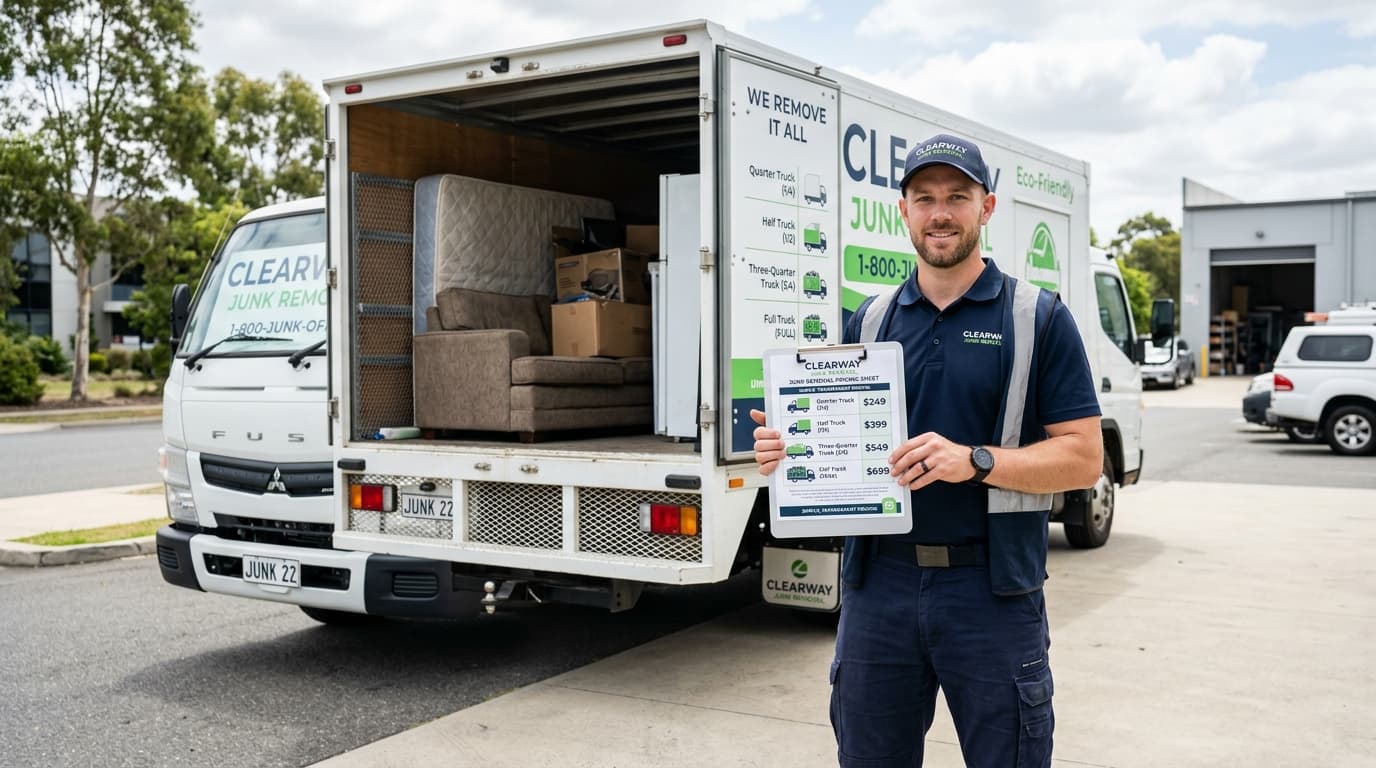
Rule 4: Laminated pricing sheet = instant trust
One of the biggest psychological hurdles for customers hiring a local contractor is fear of being scammed or overcharged. If an operator pulls up, scratches his chin, glances around the garage, and says, "Looks like about five hundred bucks," the customer immediately wonders whether that number was pulled out of thin air, inflated because of the neighborhood, or open to aggressive haggling.
The psychological power of a printed rate card
When you step out of your truck with a clean, branded, laminated pricing sheet (or an iPad running a branded digital rate card), the entire dynamic shifts.
What your on-site pricing sheet should display
A professional quote sheet should present five core elements clearly:
- Clear visual diagrams illustrating truck volume fractions (1/8, 1/4, 1/2, 3/4, Full) with cubic yard references.
- Standard load tier prices printed boldly so numbers are unambiguous.
- Itemized environmental fees for mattresses, tires, and Freon-bearing appliances.
- Access and labor modifiers for stairs, carries exceeding 75 feet, or demolition.
- Service scope guarantee stating that 2-person labor, sweep-up, transport, and lawful disposal receipts are fully included.
When you point to the chart and say: "Our 1/2 truck tier is $425. Your items come right to this line on our truck diagram, plus one $35 mattress recycling fee, making your exact total $460," on-site close rates routinely exceed 90%.
Rule 5: Never give firm quotes over the phone
When a prospective customer calls you, they will almost always ask: "Hi, how much do you charge to pick up a couch, a couple of boxes, and some garage junk?" The amateur response is to name a fixed figure like $175.
Never give a firm quote over the phone.
Why phone quotes are dangerous
Customers rarely describe their load accurately, not out of dishonesty, but because people naturally underestimate volume. A caller's "couple of boxes" routinely turns out to be twenty-eight dense boxes of books stored in an attic crawlspace. An "old couch" often turns out to be a 350-pound sleeper sofa in a finished basement around two tight corners. Once your crew arrives, the customer almost always remembers extra items in the side yard, such as a rusted grill, four tires, and an old swing set.
If you quoted $175 over the phone, the customer anchored to $175. When you arrive and tell them it's actually $380, they feel like you pulled a classic "bait and switch."
How to handle phone inquiries like a pro
Instead of a firm quote, provide a realistic bracket range and explain that your crew must confirm the final, guaranteed price on-site with zero obligation:
This script accomplishes three vital goals. It anchors the homeowner to a realistic cost bracket before your truck rolls, locks in an immediate appointment window on your calendar, and preserves complete control over your profit margin once your crew evaluates the physical pile.
Putting the 5 rules into practice
Mastering these five rules separates the haulers who burn out within six months from the operators who scale multi-truck fleets generating healthy six-figure profits.
The Profitable Operator Checklist
- Establish your base truck capacity (e.g., 14 or 16 cubic yards) and set volume tiers (1/8 to Full)
- Price your half-load at 60% to 65% of your full-truck rate—never 50%
- Establish strict surcharges for heavy bedload (dirt, tile, concrete) and regulated items (mattresses, freon)
- Print and laminate a professional, branded rate card for your truck glovebox or clipboard
- Train your dispatch and crew to offer price ranges over the phone and confirm firm prices on-site
- Review your monthly dump receipts and fuel bills against your average ticket price using our profitability tools
For national benchmarks to help calibrate your local pricing, explore our comprehensive US Junk Removal Pricing Guide. If you're building a new hauling business from the ground up, check out our step-by-step roadmap on How to Start a Junk Removal Business.