
Hoarding Cleanup Guide: Safety Levels, Costs, and Staged Protocols
Clearing a hoarded property requires more than heavy hauling; it demands a structured safety protocol, legal clarity, and emotional empathy. Learn how to assess clutter levels, protect vital records, budget realistically, and run a phased cleanup.

Quick answer: how to manage a hoarding cleanout
Managing a hoarded home requires a staged, safety-first remediation plan rather than an aggressive, single-day purge. Successful cleanouts begin by establishing clear legal authority and occupant consent, securing critical financial and legal documents, and establishing safe physical pathways before any bulk hauling begins.
Because hoarded properties frequently conceal severe biological, fire, and structural hazards, family members and property owners must distinguish between standard junk hauling and certified environmental remediation. Attempting to force a rapid cleanout without structured sorting protocols routinely leads to severe emotional trauma, destroyed family heirlooms, personal injury, and rapid behavioral relapse.
If you are coordinating a cleanout for an elderly parent, an estate settlement, or a distressed rental unit, browse verified local teams through our hoarding cleanup directory to find operators who practice discreet, respectful, and phased property clearing.
Understanding the clutter-hoarding scale
Professional organizers and remediation contractors evaluate properties using standardized clinical criteria rather than subjective impressions. The most widely adopted framework is the Clutter-Hoarding Scale (CHS) published by the Institute for Challenging Disorganization (ICD).
Understanding where a property falls across these five tiers determines whether the job can be handled by family helpers and a local hauling crew or demands professional hazmat equipment.
| Clutter Level | Physical Environment & Access | Sanitation & Air Quality | Recommended Response Team |
|---|---|---|---|
| Level 1 (Standard) | All doors and windows accessible; minor clutter on flat surfaces | Clean air; functional plumbing and utilities; no pests | Family helpers + standard junk removal crew |
| Level 2 (Light) | One major exit obstructed; narrow pathway in one room | Light pet odor; minor plumbing failure; light waste accumulation | Professional organizer + 1–2 truckload hauling crew |
| Level 3 (Moderate) | Narrow goat-paths throughout; dense clutter up to waist level | Visible mold; heavy insect activity; broken HVAC or water heater | Experienced estate cleanout crew with N95 PPE + dumpsters |
| Level 4 (Severe) | Blocked exits; compromised flooring; rooms completely impassable | Rotting organic matter; sewage backup; rodent or flea infestation | Certified biohazard remediation specialists + roll-off containers |
| Level 5 (Crisis) | Massive structural collapse risk; clutter reaching ceilings | Active animal or human biohazards; no working utilities; toxic air | Licensed hazardous waste remediation + emergency services |
Level 1 through Level 2: Manageable residential cleanouts
In Levels 1 and 2, the primary hurdle is sheer item volume rather than environmental toxicity. While clutter impedes closets, garages, and secondary bedrooms, all life-safety systems (fire exits, circuit breaker panels, smoke alarms, and bathrooms) remain fully operational.
These projects do not require full-body protective suits or commercial containment barriers. They are best managed through patient, phased sorting alongside an established hauling service. For volume calibration, refer to our Cubic Yard Visualizer to estimate truck capacity accurately.
Level 3 through Level 5: Hazardous environmental conditions
Once clutter climbs into Levels 3, 4, and 5, the physical home poses active health and life risks. Overloaded electrical extension cords buried beneath compressed stacks of old newspapers create extreme fire hazards. Decades of heavy debris cause floor joists to deflect downward under unforeseen mechanical weight.
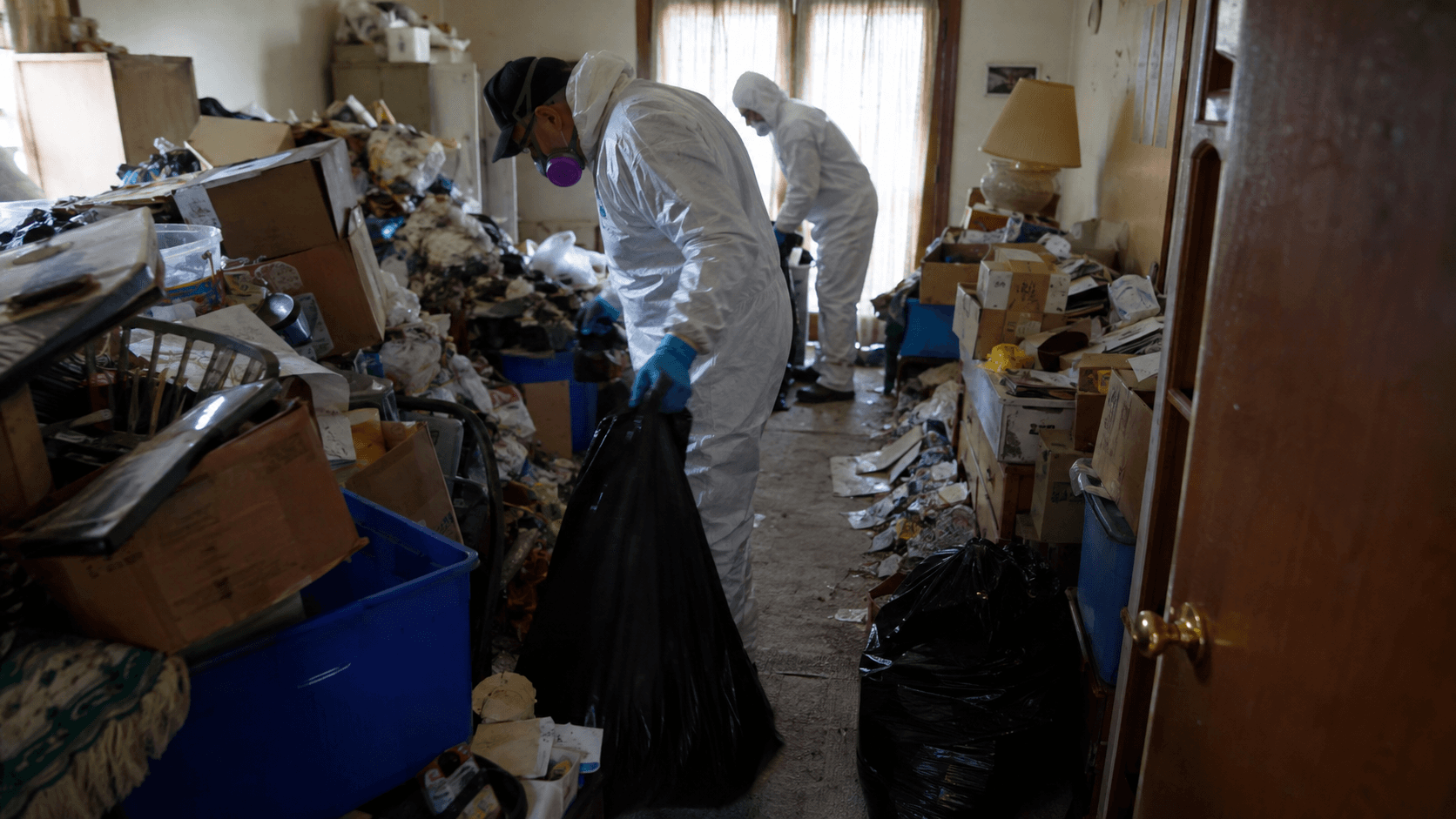
Furthermore, decaying food, rodent urine, dried feces, bedbugs, and airborne mold spores turn standard ambient air toxic. Workers inside Level 4 and 5 environments must wear comprehensive personal protective equipment (PPE), including full Tyvek suits, double puncture-resistant nitrile gloves, steel-toed boots, and NIOSH-approved P100 or PAPR particulate respirators.
Legal authority, consent, and decision-makers
One of the most catastrophic mistakes well-intentioned family members make is staging an unannounced cleanout while an occupant is hospitalized, traveling, or at work. Forcing a sudden disposal without the occupant's consent is not only emotionally devastating—it can also be illegal.
Before signing a commercial hauling contract, verify who holds legal authority over the real property and personal belongings.
If the occupant is living and possesses legal capacity, your primary objective must be building emotional trust. A forced cleanout triggers immense panic, feelings of violation, and almost always results in rapid re-hoarding within six to twelve months.
Appoint one designated family spokesperson to interface with the occupant and the work crew. When multiple relatives argue loudly over which old magazines or kitchen pots to discard, the occupant feels besieged and shuts down cooperation completely.
Standard junk hauling vs. biohazard remediation
Homeowners frequently ask whether they can save money by hiring a budget junk removal company off Craigslist for a severe Level 4 cleanout. The short answer is: legitimate hauling companies will walk away, and unlicensed crews will put everyone at legal and physical risk.
Understanding the difference between hauling and remediation protects your family from liability and contractor abandonment midway through the job.
What Each Service Lawfully Provides
- Junk haulers provide insured physical lifting, truck loading, transport, and municipal transfer station disposal.
- Biohazard teams provide negative-pressure air scrubbing, antimicrobial sanitization, and lawful medical waste manifests.
- Reputable haulers require dry, non-toxic household debris packaged in heavy contractor bags or boxes.
- Specialized remediation firms carry dedicated pollution liability and OSHA bloodborne pathogen compliance insurance.
What You Must Never Assume
- Never expect a standard junk removal crew to clean animal feces, needles, syringes, or human bodily fluids.
- Never assume an ordinary transfer station will accept unmanifested chemical pesticides or hazardous fluids.
- Do not conceal severe biological hazards from a contractor during the initial phone intake.
- Do not let unlicensed contractors dump hoarded biohazards into open commercial dumpsters on public streets.
When the primary challenge is non-hazardous furniture, boxes, clothing, and household goods, standard haulers offer unmatched speed and volume efficiency. If you are comparing equipment choices, review our detailed guide on Junk Removal vs. Dumpster Rental.
Realistic costs and budgeting factors
Hoarding cleanouts cannot be priced like standard curbside pickups. When an operator pulls up to a standard residential cleanout, two workers can fill a 16-yard truck in two hours. In a hoarded residence, the identical volume can require two full days because every drawer, box, and tote must be carefully sifted to avoid discarding family heirlooms, currency, or important deeds.
The core cost components
Professional remediation budgets consist of four primary operational expenses:
- 1.Labor and sifting hours: Technicians spend considerable time sorting items into distinct staging piles. Labor often ranges from $50 to $90 per worker-hour, or $1,200 to $2,500 per day for a multi-person crew.
- 2.Container and disposal tonnage fees: A severe cleanout rarely fits into one truck. It routinely yields three to eight 30-yard roll-off dumpsters or multiple full truckloads. Landfill scale tickets and tipping fees can total $1,500 to $4,000 alone.
- 3.Specialized disposal fees: Refrigerators, air conditioners, motor oils, paint cans, and bulk electronic waste carry itemized facility surcharges.
- 4.Biohazard disinfection and PPE consumables: Full-body protective suits, respirator cartridges, and industrial antimicrobial fogging agents add material charges.
| Scope of Cleanout | Average Duration | Typical Dumpster/Truck Volume | Total Estimated Price Range |
|---|---|---|---|
| Level 1 – 2 (1–2 Rooms or Garage) | 1 day | 1–2 truckloads (15–30 yd³) | $800 – $2,200 |
| Level 3 (Full 2-Bedroom Home) | 2 – 3 days | 3–5 truckloads (45–75 yd³) | $3,500 – $7,500 |
| Level 4 (Severe Full Residence) | 3 – 5 days | 2–4 large 30-yd³ roll-offs | $8,000 – $16,000 |
| Level 5 (Crisis Biohazard Property) | 1 – 2 weeks | Multiple containers + Hazmat | $15,000 – $30,000+ |
For broad context on how waste volumes translate into regional landfill scale expenses, review our national US Junk Removal Pricing Guide.
The four-phase cleanout protocol
Executing a cleanout systematically prevents chaotic re-sorting and reduces emotional friction. Follow this proven four-phase sequence:
Phased Cleanout Execution Sequence
- 1Safety triage and egress clearance: Establish immediate unblocked paths from every interior room to exterior exits. Locate the circuit breaker panel, water shutoff main, and gas meter, and verify that fire extinguishers are stationed at all doors.
- 2Document and asset recovery: Systematically search known hiding spots (mattress linings, freezer compartments, books, coat pockets) to retrieve passports, wills, deeds, military medals, cash, and heirloom jewelry before any bulk disposal begins.
- 3Zoned staging and categorization: Divide usable open space (such as a garage or driveway) into distinct color-coded zones: Keep, Donate/Consign, Regulated/Hazardous, and Trash. Process one room at a time, moving clockwise from the entrance.
- 4Bulk hauling and deep sanitation: Load the disposal stream into commercial trucks or roll-off containers. Once rooms are cleared down to bare subfloors, carry out HEPA vacuuming, antimicrobial scrubbing, and minor structural repairs.
Phase 1: Safety triage and egress clearance
Before tackling dense bedrooms or attics, clear the entry vestibule, main hallways, and staircases. If someone trips or a small fire sparks, workers and occupants must have an instantaneous, unobstructed exit route.
Shut off electrical breakers to rooms where clutter touches baseboard heaters or exposed wiring. Ensure adequate temporary ventilation by opening accessible exterior windows and setting up commercial box fans blowing outward.
Phase 2: Document and asset recovery
Individuals struggling with hoarding disorder often tuck life savings, uncashed pension checks, and irreplaceable family heirlooms into unremarkable containers—such as cereal boxes, old shoe cartons, or between magazine pages.
Stage a dedicated, lockable plastic tote marked "HIGH-VALUE RETRIEVAL." Only the primary designated family decision-maker should hold the key to this tote. All retrieved legal papers, banking statements, gold, and sentimental photo albums go immediately into this container.
Phase 3: Zoned staging and categorization
Never ask a hoarder: "Do you want to throw this away?" The answer will almost always be no. Instead, frame decisions around positive destinations: "Does this belong in your curated collection, or would you like to donate it so a family in need can use it?"
To learn what local charitable ministries and regional recycling centers will accept, consult our practical guide to Donation, Recycling, or Disposal.
Phase 4: Bulk hauling and deep sanitation
Once items in the disposal zone are confirmed, coordinate with your hauling crew to load vehicles rapidly. Keeping discarded items sitting on front lawns for days invites complaints from homeowner associations, neighbor disputes, and scavenging.
After clutter is cleared, assess the exposed subfloor, drywall, and baseboards for pest damage, moisture rot, and mold growth.
Privacy, neighbor relations, and crew conduct
Hoarding cleanouts can attract intense neighborhood curiosity. The sudden presence of large dumpsters, workers in protective masks, and truckloads of household items frequently draws gawking neighbors and code enforcement inspectors.
Preserving the occupant's dignity requires strict operational boundaries:
- Unmarked vehicles when requested: Professional remediation firms can dispatch unmarked white box trucks rather than brightly branded vehicles shouting "JUNK REMOVAL" across your street.
- Strict no-photography policies: Professional contracts must prohibit crew members from taking personal photos, posting videos to social media platforms, or sharing images of personal effects.
- Neighbor containment: Instruct the family lead to handle all curious neighbor inquiries with a calm, standardized script: "We are doing some scheduled interior renovations and clearing out some old remodeling materials."
- Discreet loading practices: Debris should be bagged inside the home using opaque 3-mil contractor bags before being carried across the front lawn, preventing curious onlookers from inspecting personal belongings.
Critical mistakes to avoid
Even carefully planned cleanouts can derail if common emotional and logistical pitfalls are overlooked:
- Renting dumpsters before sorting: Ordering a 30-yard dumpster before sorting begins almost always results in family members filling it with valuable antiques or legal documents that take hours to fish back out.
- Underestimating disposal volume: A home that appears to hold three truckloads routinely fills eight. Always budget a 25% financial contingency buffer for unanticipated disposal runs.
- Ignoring hazardous household chemicals: Basements and garden sheds in older homes frequently harbor banned insecticides, mercury thermometers, leaded paint cans, and pool chemicals. These cannot be placed in standard dumpsters and must go to a municipal household hazardous waste (HHW) drop-off facility.
- Neglecting personal tetanus and hygiene safety: Never allow helpers to work in athletic sneakers or bare hands. Rusty nails, broken picture glass, and hidden animal traps require heavy leather work boots and puncture-rated gloves.
- Failing to plan for ongoing maintenance: A cleanout addresses the physical symptom, not the underlying behavioral health condition. Without ongoing therapy or support from community resources, recidivism rates exceed 80%.
If you are also settling an estate following the loss of a family member, combine this strategy with our room-by-room Estate Cleanout Checklist.
Frequently asked questions
Can the local health department or fire marshal force a hoarding cleanout?
Yes. If severe clutter blocks emergency exits, creates imminent structural collapse risk, or generates pest infestations that compromise adjacent properties, municipal authorities can issue notices of violation or declare a property uninhabitable. In extreme cases, cities can remediate the property and place a municipal tax lien against the real estate.
What should we do if we find dead animals or severe biohazards?
Do not attempt to clean active biohazards using ordinary household bleach or vacuums. Standard vacuum cleaners will aerosolize pathogens throughout the home. Immediately isolate the affected room, seal the door with plastic sheeting and tape, and contact a licensed biohazard remediation company that holds OSHA Bloodborne Pathogen certification.
How long does a whole-house hoarding cleanup typically take?
A moderately cluttered 1,500-square-foot home (Level 2 or 3) generally takes two to four days with an experienced four-person crew. Severe properties (Levels 4 and 5) that require item-by-item sifting, Hazmat precautions, and multi-stage dumpster collection routinely require one to two weeks of continuous work.
How can I verify that a cleanup company is reputable?
Always ask for proof of general commercial liability insurance, workers' compensation coverage, and specific environmental/pollution disposal riders. Ensure they provide a transparent, written contract outlining labor rates, dumpster allowances, and privacy rules. For key interview prompts, read our checklist on 10 Questions to Ask a Junk Removal Company.
Professional support and health resources
- 1.Institute for Challenging Disorganization (ICD): The Clutter-Hoarding Scale (CHS) and Professional Organizer Fact Sheets. challengingdisorganization.org
- 2.International OCD Foundation (IOCDF): Hoarding Center: Clinical Resources, Support Groups, and Family Guidance. iocdf.org/hoarding
- 3.Occupational Safety and Health Administration (OSHA): Standard 29 CFR 1910.1030: Bloodborne Pathogens and Personal Protective Equipment (PPE). osha.gov
- 4.National Fire Protection Association (NFPA): Hoarding Safety and Residential Fire Hazard Prevention. nfpa.org